Bashar's Blog
Talks around Computer Science and Stuff
PHP client for Optimal Netbanx (Card payment)
In: PHP
18 Aug 2015I recently released a PHP client to consume Optimal Netbanx services on Github.
https://github.com/alfallouji/PHP-Optimal-Netbanx
You can integrate your application using this agnostic Card Payments API to process all major credit cards through the NETBANX payment gateway.
It implement a wide variety of REST-based API requests – including purchases, refunds, and authorization reversals. Obtain output in JSON format – it’s easy to parse in a large variety of Web and mobile applications.
An account with Optimal Payment is needed in order to use this library. You can create testing account here : https://developer.optimalpayments.com/en/
This library can be loaded via composer. This is an open source project, feel free to contribute !
A very interesting concept – IFTTT
In: Uncategorized
16 Feb 2015I just discovered a new web application named IFTTT.
The concept is so simple and so powerful at the same time.
It allows to create simple rule : If This Then That
Where “This” is a trigger and “That” is an action. Both happens in what they call “Channels”. Channels are applications like Facebook, Linkedin, Weather, Email, etc.
In a nutshell, you can build an integration between third parties in a matter of seconds.
Here are some examples of rules :
– Show your support for the Texas Rangers on Twitter every time a game starts
– Post videos from your YouTube favorites playlist to Tumblr
– Build a Twitter List from a specific #hashtag
If you are interested to know more : https://ifttt.com/wtf
I also encourage you to create an account and try it.
1st PHP Australia Conference
In: Uncategorized
16 Feb 2015The first annual PHP Australia Conference will be in Sydney in 4 weeks !
http://www.phpconference.com.au/
Don’t miss this exciting event !
Cya there.
2014 – Open Source Developer’s Conference @ Gold Coast
In: Uncategorized
18 Sep 2014I am glad to learn that I will be a speaker at the 2014 OSDC in the Gold Coast : http://2014.osdc.com.au/
Not only, this is going tobe a very interesting conference seeing the different talks and speakers, but also you can expect some good fun in the Gold Coast.
Hope to see you there !
DHL XML API Webservice
27 Jul 2014I recently had to work on integrating an ERP with DHL XML API Services. I could not find a PHP open source library to consume their API, so I decided to share the one that I wrote.
You can download the code on github : https://github.com/alfallouji/DHL-API
If you want to read documentation about the DHL XML API Service, their toolkit can be downloaded from here: https://xmlpi-ea.dhl.com/
Description
The library is a PHP Oriented Object client for the DHL XML API Services. DHL XML Services is an online web services integration capability that provides DHL’s service availability, transit times, rates, shipment and courier pickup booking along with shipment tracking from over 140 countries around the world. Using DHL’s XML Services, customers can incorporate DHL shipping functionality into their websites, customer service applications or order processing systems.
Usage
The client does not rely or depend on any framework and it should be fairly easy to integrate with your own code. You can use the autloader that is provided or your own autoloading mechanism.
The sample folder contains examples on how to use the client and perform requests to DHL XML API, such as track a shipment, create a shipment, request a pickup or print labels.
In order to have the samples working, you will need to create a DHL staging account. You can do that by going to that URL : DHL – XML API Services
Then, you need to edit the config/config.php file and provide your account id and password. The samples use those credentials.
return array(
‘id’ => ‘Your_DHL_ID’,
‘pass’ => ‘Your_DHL_Password’,
);
New features for Fxalert.net
In: Uncategorized
20 Oct 2012I was able to invest time on improving the UI and adding new features to fxalert.net.
Fxalert.net is a web application allowing to create simple and advanced email and SMS alerts on the forex market. It supports more than a 100 of currencies pair.
The new features includes the following :
– Integration with facebook (you can now use your facebook account to login);
– UI Revamp;
– You can now create SMS / Mobile alert for up to 10 different countries and it supports more than a hundred of mobile providers;
– Aggregation of forex news from twitter and around the web;
– New FAQ section.
I hope people will like and find useful this new version.
Watch starwars online for free
In: Fun and stuffs
27 Nov 2011Open your shell script and type :
telnet towel.blinkenlights.nl
Enjoy 🙂
A new email currency alert system: www.fxalert.net
In: Uncategorized
15 Sep 2011I recently developed for fun a webapp offering forex currencies alert. It allows users to create 100% free custom currencies alert on approximately 100 currency pairs.
Alerts are sent by email for now, but others channels will be available soon such as SMS, IM.
You can check it out at www.fxalert.net.
Any feedback is welcome 🙂
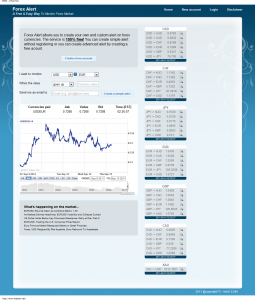
www.fxalert.net
Mikogo Linux Version Beta Started
In: Uncategorized
4 Jul 2011On my last post, i mentioned that there should be a linux version of Mikogo. I just received an email a couple days ago informing me the beta started.
I am going to try it and will post some results / feedback here.
It seems very promising !
Mikogo A Nice Free Web Conferencing Application
In: Uncategorized
22 Apr 2011A few months ago, Salesforce acquired DimDim (the web conferencing tool) and they decided a change of strategy. For us users, that means no more DimDim as a free web conferencing application.
As a consultant, I often need to use web conferences and since the old DimDim days were over, I started looking for a new one.
After doing some searches and tests, I discovered Mikogo.

Their features list is pretty complete and wide. It is a completely free (without any ads) service.
I did some tests and it works really good. So, if you were like me, looking for a solid and free web conferencing service, I highly suggest you to try it out.
Their windows client is very light, and they support Windows & Mac. They also working on a linux distribution ! They have started beta invite yesterday, you can register for the beta here : http://www.mikogo.com/2011/04/21/mikogo-linux-beta-testers/
By spending some time reading their forums, it seems they have a nice community of users also.
Who am I?
My name is Bashar Al-Fallouji, I work as a Enterprise Solutions Architect at Amazon Web Services.
I am particularly interested in Cloud Computing, Web applications, Open Source Development, Software Engineering, Information Architecture, Unit Testing, XP/Agile development.
On this blog, you will find mostly technical articles and thoughts around PHP, OOP, OOD, Unit Testing, etc. I am also sharing a few open source tools and scripts.
- Trinzia: Well done, my friend! [...]
- vivek raj: Hello Bashar, It's really good that you wrote this code. but I'm confused some part. can you suppor [...]
- irfan: I saw watch your youtube talk on clean and testable code. By the way very good talk. I was wondering [...]
- Mohamed: Hello bashar, I hope you are doing well. Thank you for your hard work, and thank you for sharing [...]
- alex davila: Hi Bashar is there any pick up example?? Regards Alex Davila [...]
- AWS CloudHSM workshop
- Optimizing definition of inbound rules for security groups in AWS
- Generating set of data
- All 5 AWS Certifications done
- AWS Solution Architect Professional Certification
- Two left
- One more – three left
- Just got my AWS Solutions Architect Certification
- AWS Solution Architect Certification
- Creating a search for your application with Solr and PHP
Categories
- Apache (1)
- MOD_REWRITE (1)
- MOD_SQLALIAS (1)
- AWS (9)
- Design Pattern (5)
- Editor (1)
- Fun and stuffs (2)
- Knowledge (1)
- Logging (1)
- Others (3)
- PHP Framework (2)
- Programming language (18)
- PHP (16)
- Scalability (1)
- Source Control (1)
- Text Mining (1)
- Uncategorized (11)
- Unit Testing (2)
- User Experience (1)
Archives
- April 2021
- November 2017
- September 2017
- August 2017
- July 2017
- June 2017
- September 2016
- August 2015
- February 2015
- September 2014
- July 2014
- October 2012
- November 2011
- September 2011
- July 2011
- April 2011
- December 2010
- May 2010
- April 2010
- March 2010
- October 2009
- September 2009
- August 2009
- June 2009
- May 2009
- April 2009
- March 2009
- February 2009